
How We Can Develop Healthier Self Esteem, Self-Acceptance and Confidence
"I’m still insecure about my own worthiness." Natalie Portman
"I'll never make enough films to purge all my fears." Steven Spielberg
"The only way out of that pain of the absence of self-acceptance was to claw, study, fight, beg and inch my way toward it." Elizabeth Gilbert
“Or maybe, just maybe, they’re right, and you’re sometimes quite good at what you do.” Bill Nighy
“When you perceive multiple subtleties and complexities, there is naturally more to be anxious about." Paula Prober
Programs and Resources
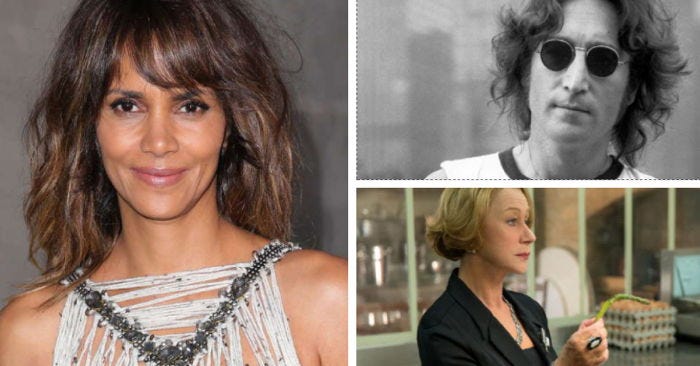
Halle Berry, referring to being abused as a child by her violent father, who also assaulted her mother, said: “I think I’ve spent my adult life dealing with the sense of low self-esteem that sort of implanted in me. Somehow I felt not worthy.”
“The research shows that healthy self-compassion increases our inner drive, our resilience, and our ability to excel.” Kristin Neff
~~~~
Insecurity, unhealthy levels of self-criticism and self esteem, impostor feelings, low self-acceptance, poor self-compassion, worrying and anxiety...
Doesn't high ability and accomplishment move people past these feelings? No.
But are these kinds of emotions always 'bad' and need to be overcome? Also, no.
Being creative, sensitive, and smart does not provide emotional immunity.
Psychotherapist Paula Prober notes she works with clients who are "particularly curious, creative, sensitive, and smart. I call them people with rainforest minds."
She comments, "I’ve known many rainforest-minded humans who are quite anxious. Being extra aware, sensitive, and creative can be fertile ground for extreme worry and self-doubt.
“When you perceive multiple subtleties and complexities, there is naturally more to be anxious about." From her post The More You Know, the More You Worry.
~~~
"I’m still insecure about my own worthiness."
Natalie Portman talked in her 2015 Harvard Commencement Speech about impostor feelings and other kinds of insecurity that so many artists report experiencing, and many of us relate to.
She said, “Today I feel much like I did when I came to Harvard Yard as a freshman in 1999.
“I felt like there had some mistake, that I wasn’t smart enough to be in this company. And that every time I opened my mouth, I would have to prove that I wasn’t just a dumb actress.
“I have to admit that even twelve years after graduation I’m still insecure about my own worthiness."
See much more from Portman and other artists in my post How Creative People Feel Insecure, and How to Gain Confidence.
…
Natalie Portman once told a news publication that she had considered leaving acting to become a vet or a clinical psychologist.
She has achieved multiple recognitions for her acting, including an Academy Award for Black Swan.
She is considered fluent in Hebrew and French, and conversational in Japanese, German and Spanish. (Perplexity AI search summary, with multiple sources.)
She graduated from Harvard with a psychology degree in June 2003.
The Harvard Crimson, student newspaper of the university, reported in a 2011 article that Law School Professor Alan M. Dershowitz considered Portman an exceptional student.
“She was in my seminar called Neuropsychology and the Law, and I didn’t know who she was because her name was Natalie Hershlag,” he said, referring to Portman’s birth name. “It was a few weeks into the semester that I learned she was an actress—but she was a terrific student.”
Portman’s paper on new methods of lie detection earned her an A+ from Dershowitz - the highest grade in the class. After that, Dershowitz hired Portman as a research assistant for a book he was writing.
“We talked a lot about her career,” he says. “She said she wanted to do acting, and she wanted at some point to be a psychologist.”
But Dershowitz in no way considers Portman’s divergence from psychology to be disappointing.
“It’s all about choice,” he said. “And she has choices and options. She would be a great psychologist, and she’s a great actor. She probably influences more people in her acting.”
Dershowitz also said that he does not consider the two fields mutually exclusive. “Her psychology background helped her in formulating the role for [Black Swan] … She’s an actor who uses her academic background,” he said.
From my article Gifted Child, Uncommon Adult: Natalie Portman.
~~~~
Writer, producer, director Steven Spielberg is often attributed for the quote: “I still have pretty much the same fears I had as a kid. I’m not sure I’d want to give them up; a lot of these insecurities fuel the movies I make.” (source not found)
He also said, "I think every film I make that puts characters in jeopardy is me purging my own fears, sadly only to re-engage with them shortly after the release of the picture. I'll never make enough films to purge them all." (imdb profile)
~~~
Our self-concept, positive self-regard and resulting confidence, are key influences on how fully we realize our talents and live our lives.
What impacts our levels of self-esteem, self-appreciation, self-compassion, and what can we do to nurture and support our emotional health?
~~~~~~~~~~~~~~~~~~~~~~~~~~~~~~~~~~~~~~~~~~~~
Programs and Resources
Self-Acceptance programs from Sounds True:
* Radical Self-Acceptance by Tara Brach
* The Self-Acceptance Summit recordings
* Unconditional Self-Acceptance by Cheri Huber
* and more
* Self-Compassion Step by Step - Audio, CD
* The Power of Self-Compassion - Online Course
* Understanding Narcissism - Online Course - Various Presenters
* The Yin and Yang of Self-Compassion - Audio
* and more
» Confidence and Self esteem video list - Self concept, self-regard, self-compassion, self esteem, self-worth, identity, self acceptance, confidence, impostor feelings.
~~~~~~~~~~~~~~~~~~~~~~~~~~~~~~~~~~~
Elizabeth Gilbert on Self Acceptance
Author Elizabeth Gilbert (“Eat, Pray, Love” and “Big Magic: Creative Living Beyond Fear”) is one of the speakers at the Self-Acceptance Summit produced by Sounds True.
Host Tami Simon: Let’s start right with self-acceptance as a topic that you care about – why is this an important topic to you personally
Elizabeth Gilbert: Well, I mean I’ve kind of been a student of it my whole life because I’ve had to be, because its absence – it’s moments of absence – in my life have brought me the darkest pain I’ve ever been in.
And the only way out of that pain of the absence of self-acceptance was to claw, study, fight, beg and inch my way toward it.
And it’s been what I’ve been up to for a long time, and it’s something that I still have to work on.
And there are times where I lose it. I’d have to find my way back to it again and again and again – which of course always means finding your way back to your heart – it’s the only place you’re ever gonna find it.
Elizabeth Gilbert on Self Acceptance
"I’ve kind of been a student of self-acceptance my whole life because I’ve had to be." Author Elizabeth Gilbert (“Eat, Pray, Love” and “Big Magic: Creative Living Beyond Fear”) was one of the speakers at the Self-Acceptance Summit produced by Sounds True.
~~~
More from speakers at the Self-Acceptance Summit:
“There is one relationship that affects your life more than any other. No matter who you are, what you do, or what you want to achieve, it is this essential relationship that influences every step you take on your life journey: Your relationship with yourself. Yet how many of us experience dysfunction with this most essential relationship?" - From a Sounds True page for the Summit.
"Our brains are wired to be critical of ourselves and compassionate towards others because they are instinctively driven to seek acceptance from a group. The trick is learning to turn our natural compassion inward as well as outward." - Kelly McGonigal
“I naively believe that self-love is 80 percent of the solution, that it helps beyond words to take yourself through the day as you would with your most beloved mental-patient relative, with great humor and lots of small treats.” ― Author Anne Lamott (one of the many speakers)
Hear the full length video interview with Elizabeth Gilbert and many others at the Self-Acceptance Summit: See link on page: Self-Acceptance programs from Sounds True.
~~~~
Kristin Neff on how self-compassion benefits us.
“The research shows that healthy self-compassion increases our inner drive, our resilience, and our ability to excel." - Kristin Neff, PhD
“In a nutshell, self-compassion is treating ourselves with the same kindness, care, and understanding that we would offer to others when they suffer, fail, or feel inadequate.”
Researcher, teacher and author Kristin Neff specializes in how self-compassion benefits us.
Here is a short video related to one of her courses:
Self-Compassion author and researcher Kristin Neff says:
“We often become our own worst critic because we believe it’s necessary to keep ourselves motivated.
“Self-criticism does not build self-esteem by constantly measuring ourselves against everyone else.
“A strong sense of self-compassion is an essential ingredient for success.”
* Self-Compassion Step by Step - Audio, CD
* The Power of Self-Compassion - Online Course
* Understanding Narcissism - Online Course - Various Presenters
* The Yin and Yang of Self-Compassion - Audio
* and more
~~~~
Being a highly sensitive person can impact our feelings of self-worth
Many, if not most, artists and creators are highly sensitive people, and can be more vulnerable to self-criticism and other experiences that impact self-esteem, confidence and more.
Julie Bjelland, LMFT is a psychotherapist, author and empowerment coach specializing in the trait of high sensitivity, and is a highly sensitive person herself.
One of her podcasts episodes is 117: Confidence: Let’s Explore Where it Comes From and How to Get it, with Julie & Willow at The Sensitive and Neurodivergent Podcast on the Sensitive Empowerment site of Julie Bjelland, LMFT - where you can find many more of her articles, books, courses, Sensitive Community and other resources.
She writes in the show notes:
“I’ve noticed that so often something gets in the way of HSPs believing and accessing Confidence.
“Many of us have received messages our whole life that something is wrong with us for being so sensitive.
“Or maybe we have been so overwhelmed by the challenges of our sensitive nervous system that we are in survival mode, instead of truly living our life with purpose.”
She asks “What is stopping you from what you want?
“What would you need to do to find it and let go of what’s holding you back from accessing the most beautiful parts of yourself and your inner gifts?
“I’ve been hearing a lot of HSPs be held back from the worry of judgment from others or being different or listening to others’ expectations of you, or even self-judgment and fear of failure.
“Why is that? What would it take for you to let go of that?”
How does confidence affect our lives and how can we feel it more? (Excerpt from the full podcast):
How does confidence affect our lives and how can we feel it more?
This is a short excerpt from a podcast episode with Julie Bjelland and Willow McIntosh on the topic of confidence. They are addressing highly sensitive people, but confidence is an issue for so many - even most - creative people. From the Show Notes for the original episode:
The image above is actor Bill Nighy, who once commented:
“You come to realize there is this huge disparity between what you think about yourself and your work and what other people think about you and your work, at first you either think they’re insane or that it’s a conspiracy to make you look stupid.
“Or maybe, just maybe, they’re right, and you’re sometimes quite good at what you do.”
From my article Nurture your healthy self-esteem to thrive as an actor and artist.
~~~~~
Many creative people report feeling incompetent, inadequate and having low self-esteem or unhealthy self-regard at times. But there are ways to shift those feelings.
“So many artists and actors only believe in their own gifts once an agent, a casting director or a producer has declared and affirmed their merit.” Natalie Roy
“Just because you’re an actor doesn’t mean you’re not going to have the same insecurities as everyone else. If anything, it’s magnified.” Eva Noblezada
“Self-doubt is creeping in your mind. A part of you knows you are a performer. A part of you doubts who you are.” – Psychotherapist Mihaela Ivan Holtz.
Here is a short video of mine with more quotes:
Psychotherapist Mihaela Ivan Holtz addresses this topic of self-esteem – especially crucial for actors and other performers.
She writes:
Have you struggled a long time with low self-esteem?
Are your feelings the result of poor treatment as a child or has something more recent left you questioning your worth?
The external pressure to be more and do more can wear down anyone’s self-esteem.
Especially if the past is informing your perception of your abilities, skills, talents and overall potential.
If you are a highly creative person – someone with a big drive or determination to achieve your life goals or dreams – an injured self-esteem will show up in your journey over and over again…
It will interfere with your ability to invest yourself in creating your life.
An unrealistic or harsh internal voice can repeatedly stifle your creative spark or disconnect you from your performing abilities.
As challenging as it may feel, when your self esteem issues are triggered it’s an opportunity for you to heal and build a healthier and more grounded sense of self-worth.
See more in her article How EMDR Can Help you Heal Low Self-Esteem
See more in my article
Nurture your healthy self-esteem to thrive as an actor and artist
~~~~~~
John Lennon once expressed a perspective on some of the self esteem challenges experienced by many creative people:
“Part of me suspects that I’m a loser, and the other part of me thinks I’m God Almighty.”
He also said: “There was something wrong with me, I thought, because I seemed to see things other people didn’t see.”
Therapist Sharon Barnes works with creative, sensitive, intense and/or gifted teens and adults, and hears from many of them statements like Lennon made.
She has developed a home-study video program to help creative people – see more in my article: Creative people can feel “There’s something wrong with me.”
~~~~
Helen Mirren has portrayed many confident, even imperious, women in her long and successful career.
But personally, as she commented in a British newspaper interview, she has experienced insecurity throughout her life.
She emphasized that it should be called “experienced” rather than “suffered” – a helpful framing of what is often perceived as a negative feeling.
“I’m beginning to get a bit fed up of all this ‘suffering’. But yes, I have experienced insecurity all my life, and I still do on a daily basis.”
From article: How to build your confidence as an artist
~~~~~~~
“The deepest principle in human nature is the craving to be appreciated.”
– Psychologist William James.
Our needs for attention and appreciation may be basic, and grounded in survival as a child, but for some people, those needs are especially potent.
Ben Kingsley has commented about being a performer as a child, and like so many other people, experiencing some hurtful responses from his parents.
“I had always been the song-and-dance man of the family,” he says.
“I remember my father referring to me as ‘our little Danny Kaye’ when I was about seven. That was the only remotely positive comment I remember from them.
“They never praised me or acknowledged a gram of talent in me.
“Their way was to mock – ‘when are you going to finish with this acting lark’, that sort of thing. My mother, far from being proud, was very jealous of my success.”
[She was an actress, with only a few small roles, according to Kingsley.]
His interviewer notes that mention of being knighted, in 2002, “seems to make Kingsley glow.”
“I told you about my parents, and the fact that any kind of embrace was totally absent from my life,” he says.
“So to be embraced by Her Majesty… I felt like stopping people in the street, saying my mum loves me, you know. Because that’s what it felt like, to me. The filling of a vacuum in the universe.”
See more in article :
~~~~~~~
Comedian, writer and actor Amy Schumer has related an experience of her low esteem and confidence:
“Right before I left for college, I was running my high school. … People knew me. They liked me. I was an athlete and a good friend. I felt pretty, I felt funny, I felt sane.
“Then I got to college in Maryland. My school was voted number one … for the hottest freshman girls in Playboy that year.
“And not because of me. All of a sudden, being witty and charismatic didn’t mean sh*t.
“Day after day, I could feel the confidence drain from my body. I was not what these guys wanted. They wanted thinner, blonder, dumber.”
[Photo is from her imdb section.]
~ ~ ~
Psychologist and author of multiple books about highly sensitive people, Elaine Aron, PhD notes:
“In spite of our focus on raising self-esteem, we have had little success.
“In fact, research [indicates] low self-esteem is in a sense natural, one result of our instinct to rank ourselves among others…
“Repeating self-affirmations, the most common self-help treatment, only increases low self-esteem in those already feeling bad, as many hapless souls have found.”
See more in post: Ranking and Self-Esteem on the Highly Sensitive site.
One of her books is The Undervalued Self – here is a video about it:
~~~
“The most creative people are typically not models of high self-esteem.”
Elizabeth Mika, a provider of assessment for gifted children and counseling for gifted adults, notes:
“High self-esteem is something we, Americans, all want.
“To be sure, a similar obsession with self-esteem is rarely, if ever, found in other civilized countries, whose languages often do not even possess an adequate equivalent of the term.
“Here, however, self-esteem is a major preoccupation of psychologists, educators and pundits alike.
“Whole enterprises are built on the conventional wisdom which teaches us that high self-esteem is good, while low self-esteem can be hazardous to our health.”
She adds, “Let’s face it, having chronically high self-esteem is often a sign of either stupidity, delusion, or a lack of conscience — or all three combined.
“So what is so desirable about it? The feeling-good-no-matter-what part?
“On the other hand, the most creative and morally advanced people are typically not models of high self-esteem.
“Their inner lives are often plagued by self-doubt, worries, fears, and feelings of inferiority.
“One reason for this chronic insecurity is that they base their self-evaluations on very high personal standards, and thus their own behavior seems inadequate and far from ideal in comparison.
“But this insecurity is usually a sign of an active conscience at work.
“Moreover, the insecurity and the demons it feeds, are necessary elements of a creative temperament and we have plenty of evidence that without them no meaningful creative efforts, especially in art, can be undertaken.”
She quotes Czeslaw Milosz, Polish poet and writer, and a Nobel laureate:
“From early on writing for me has been a way to overcome my real or imagined worthlessness.”
Read more in her article What Is Wrong With Feeling Good?
Another example of a highly talented and accomplished actor with imposter feelings is Meryl Streep, who has said, “I have varying degrees of confidence and self-loathing.
“You can have a perfectly horrible day where you doubt your talent… Or that you’re boring and they’re going to find out that you don’t know what you’re doing.”
Read more in post: Gifted and Talented but Insecure.
~ ~
Some more examples of impostor feelings and thinking:
Lupita Nyong’o had not yet graduated from Yale Drama School when she was cast by Steve McQueen for his powerful movie 12 Years a Slave.
She said, “I had impostor syndrome until the day I landed in Louisiana [for the shoot].
“I was certain that I was going to be fired.”
~ ~
“Any moment, someone’s going to find out I’m a total fraud.” (Emma Watson)
“I convince myself I’m fooling people.” (Jonathan Safran Foer)
“I felt inadequate the entire time I was in graduate school.” (Rosalyn Lang, Ph.D.)
Read comments by other artists, and by coaches and psychologists, in my article Overcome Impostor Syndrome Feelings.
~~~~~
Confidence and body image
Lady Gaga is among many performers who have talked about experiencing self esteem challenges and insecurity.
In a magazine interview, she commented:
“I’m confident in who I am. I’ve come to a place in my life where I’ve accepted things that are me, as opposed to feeling pressure to explain myself to people around me. That’s just the way I’ve always tried to be. It didn’t change when I became a star.”
Interviewer: “But do you consider yourself to be beautiful?”
“Not conventionally beautiful. If there was some sort of mathematical equation for beauty, I don’t know if I would be the algorithm.
“I’ve always been OK with that. I’m not a supermodel. That’s not what I do. What I do is music. I want my fans to feel the way I do, to know what they have to offer is just as important, more important, than what’s happening on the outside.
Interviewer: “I think that’s interesting. Because every time I see a shot of you stripped down without makeup or a costume, I’m struck by your physical beauty. Your layering of costumes—is that because of insecurity? Are you afraid of what’s under all those layers?”
“I would say that I am. Maybe it’s from the things I experienced in my past, you know?
“Being beautiful is not so fun when you’re in a business with all men.”
From The Monster Talent: Lady Gaga By Andy Cohen, Glamour October 29, 2013.
This photo of Lady Gaga is also used in my post Emotional Intelligence To Be Creative, which includes material about her work with the Yale Center for Emotional Intelligence and Born This Way Foundation.
[Over the years, I have collected many quotes on body image.]
Trauma and self esteem
Lady Gaga was bullied, even thrown into a trash can. She said, “I was called really horrible, profane names very loudly in front of huge crowds of people, and my schoolwork suffered at one point.
“I didn’t want to go to class. And I was a straight-A student, so there was a certain point in my high school years where I just couldn’t even focus on class because I was so embarrassed all the time. I was so ashamed of who I was.”
Another artist who suffered abuse and this kind of erosion of self esteem is Halle Berry.
Referring to being abused as a child by her violent father, who also assaulted her mother, she said:
“I think I’ve spent my adult life dealing with the sense of low self-esteem that sort of implanted in me. Somehow I felt not worthy.”
One of the dynamics of acting may be in allowing people to “step away” from their painful histories and hurt selves by “becoming” someone else for a time.
Berry commented about acting in her intense movie “Gothika” (2003):
“Although physically I would feel exhausted and tired, my back would hurt, my arms would hurt and my feet would be raw from running through all the stuff, there was still something about it that felt good, like I had a cathartic experience.
“I got a lot of stuff out of me that was pent up in little corners of myself, so I felt good at the same time.”
Quotes are from my article Creative People, Trauma and Mental Health.
~~~~~~~
The quiet ego
This image is from the book: Transcending Self-Interest: Psychological Explorations of the Quiet Ego by Heidi A. Wayment, Jack J. Bauer, Editors.
The Amazon.com summary notes the term quiet ego refers to “an ego less concerned with self-promotion than with the flourishing of both the self and others.”
In his post on the site of Susan Cain, psychologist Scott Barry Kaufman refers to this book and notes
“The researchers found that those with a quiet ego reported being more interested in personal growth and balance and tended to seek growth through competence, autonomy, and positive social relationships.
“While a quiet ego was positively related to having a higher self-esteem, it was also related to various indicators of self-transcendence, including prosocial attitudes and behaviors.”
He adds, “This is consistent with the idea that a quiet ego balances compassion with self-protection and growth goals. Indeed, a quiet ego is an indication of a healthy self-esteem—one that acknowledges one’s own limitations, doesn’t need to constantly resort to defensiveness whenever the ego is threatened, and yet has a firm sense of self-worth and value.”
From article The Surprising Benefits of a Quiet Ego.
Scott Barry Kaufman is author of books including Ungifted: Intelligence Redefined and Wired to Create: Unraveling the Mysteries of the Creative Mind.
Susan Cain is author of Quiet: The Power of Introverts in a World That Can’t Stop Talking.
For more on being an introvert and/or highly sensitive, see:
site: Highly Sensitive and Creative
Resources for Introverts and Highly Sensitive People
Programs for Introverts and Highly Sensitive People
~ ~ ~
A comic take on all this self-esteem stuff, from The Big Bang Theory TV series:
Leonard Hofstadter (a physicist at Caltech, played by Johnny Galecki): I am clearly not the only person who is tormented by insecurity and has an ego in need of constant validation.
Sheldon Cooper (also a physicist; played by Jim Parsons): So you admit you’re an egotist?
Leonard Hofstadter: Yes! … I could never please my parents, so I need to get all of my self-esteem from strangers like you.
From the episode: The Cooper-Hofstadter Polarization (2008) (Video)
[Photo is from another scene from the show, probably not this episode.]
~~~~~~~
Some related articles from my various sites:
Self-Knowledge, Self-Esteem and the Gifted Adult by Stephanie S. Tolan
“Self-identification as a gifted adult is complicated by the great diversity among the gifted adult population. What does a gifted adult look like? Unfortunately, for many gifted adults, it looks like somebody else.”
Self-esteem, Self-confidence and Trusting Your Creative Self
If we are willing to put our creative work out there – into the world in some way – it will be judged and ranked. But what if our book doesn’t make it to a bestseller list, our painting is not accepted by a gallery, our blog doesn’t show up on a Google page one, or our movie doesn’t get invited to a film festival? One consequence is we may feel deflated, and question our worth as a creator.
Can self-esteem distort our personal development?
A study led by San Diego State University psychologist Jean Twenge [titled “Egos Inflating Over Time”] warns that years of school self-esteem programs and media that “promotes the self relentlessly” could cause significant personal and social problems for people reaching adulthood.
Building self esteem and identity – what we tell ourselves about ourselves
How we identify and classify ourselves can have a profound impact. Director Jane Campion (photo), praised for “The Piano” and other films, once commented, “I never have had the confidence to approach filmmaking straight on.
“I just thought it was something done by geniuses, and I was very clear that I wasn’t one of those.”
~~~~~~~
Do you enjoy and benefit from my posts, podcast episodes, videos and more?
As a writer and content entrepreneur, I love researching, creating and publishing material here, and on other Creative Mind Sites, that can help creative people learn more and thrive more.
But creating and publishing is only free in some ways.
Consider supporting my work with a donation.
One key tool is my desktop computer. (The image is for illustration, it is not mine and that is not me.) Your donation would help pay for a recent upgrade to a newer (still old, from 2017, but refurbished) iMac, which enables my ongoing work.
Other costs include hosting fees (over $120/mo) of my 7 personal sites, and there are other expenses including a podcast platform, video editor, and digital production apps.
Thanks for considering a donation to help. Much appreciated. Douglas
~~~~~~~
~~~~~~~~


